


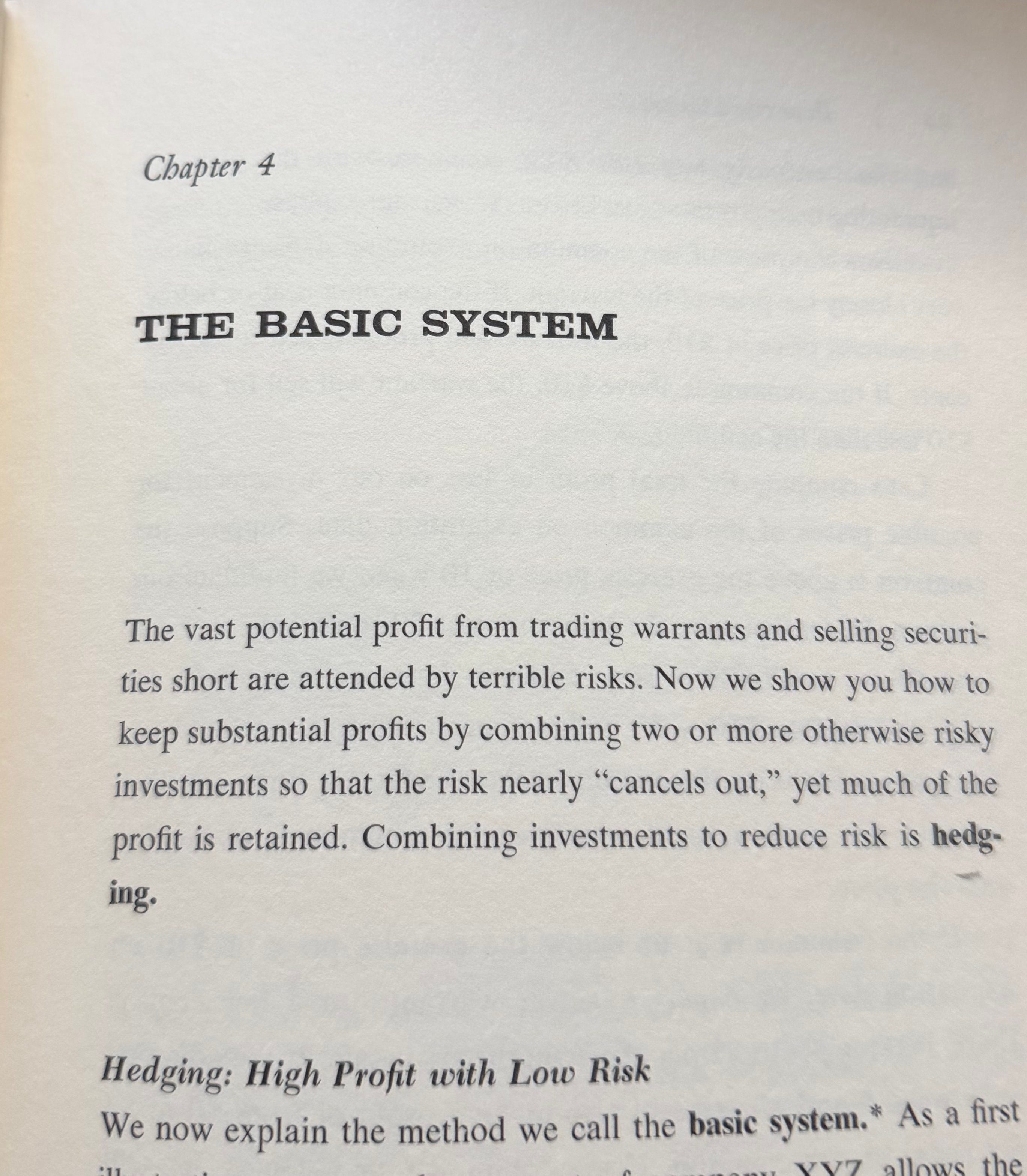
In 1967, Ed Thorp and Sheen Kassouf published Beat the Market. Chapter Four opens with a line I still think about:
“The vast profit potential from trading warrants and selling securities short are attended by terrible risks. Now we show you how to keep substantial profits by combining two or more otherwise risky investments so that the risk nearly cancels out, yet much of the profit is retained.”
—Beat The Market 1967
That’s hedging. High profit with low risk. That’s the whole game played inside this publication.
This week’s video walks through one live position from the Machina Capitalis playbook. It’s not a theoretical example, it’s an actual trade. Showcasing what this looks like in practice in its most basic form is the aim.
The trade
On 26 May, Abacus Global (ABL) was trading at $8.98. I bought 1,500 shares and simultaneously sold 15 call options at the $7.50 strike, expiring 15 January 2027.
That’s it. That’s the entire structure. Buy the stock, sell a call so deep in the money that most of its value is intrinsic, not extrinsic. No ratios, no delta-neutral engineering. Sometimes the returns I seek are made simple enough by the premium offered by the market and I don’t have to use any of the aforementioned techniques. Here’s what the setup did for me:
Premium collected: $2.47 per share
Effective cost basis: $6.51 (versus $8.98 spot)
Downside cushion: 27.5% — the stock can fall over a quarter before I lose a cent
Locked-in profit: $1,485 on $9,765 of capital deployed if assigned.
Return on capital: 15.2% over 234 days — annualising to ~ 24%
Since entry, ABL has run to $10 — past the strike, tracking toward max profit and I haven’t touched the position once.
Important — Compare that to buying the 1,500 shares uncovered. At today's price of $10, the naked stock is up 11.4%, with no downside protection at all . Any drop below $8.98 and it’s straight into a loss. My hedging has already locked in 15.2%, with a 27.5% downside buffer before I lose anything. Currently, it's not even a trade-off: I'm beating the naked stock on return while carrying a fraction of the risk. The only cost is going forward: my covered call has hit its ceiling and won't earn another cent, while naked shares would keep running with the stock in the event of a strong rally.
Past performance is no guarantee of future performance. This is not investment advice — it’s a transparent walkthrough of one operator’s process.
Why this matters more than the number
The 24% isn’t the point. The point is how little it costs me to get it. Once the trade is entered I only keep a cursory eye on it to see if the stock price approaches the breakeven point of $6.51 anytime from entry until expiration. I’m not forecasting Abacus. I’m not bullish or bearish on it. I built a spread with a locked profit margin and a large error buffer and then I turn my attention elsewhere.
That matters because Machina Capitalis isn’t a portfolio I manage from a desk. It’s built to run from whatever time zone I happen to be in, therefore I want it to be as simple as possible.
The scaling logic
I think of this type of positions as one player on a team. Run twenty positions like it, each capped at 5% of the book, spread across uncorrelated names, and I get a diversified income engine with no single-month blow-up risk — while still yielding something in the mid-20% per year on capital that simultaneously has a lower risk profile thanks to the in-built downside cushion.
In my previous piece, I examined the relationship between returns, living expenses and required working capital requirements needed to have a realistic shot at running this as a serious business from which to make a living.

In many large Cities outside of the OECD countries, a family of 4’s cost of living is estimated at approximately $30-$55,000 USD, with Asia being the best value.
The estimates in the above article are supported by our friend BowTiedMara who was kind enough to share his expenses this week on X.
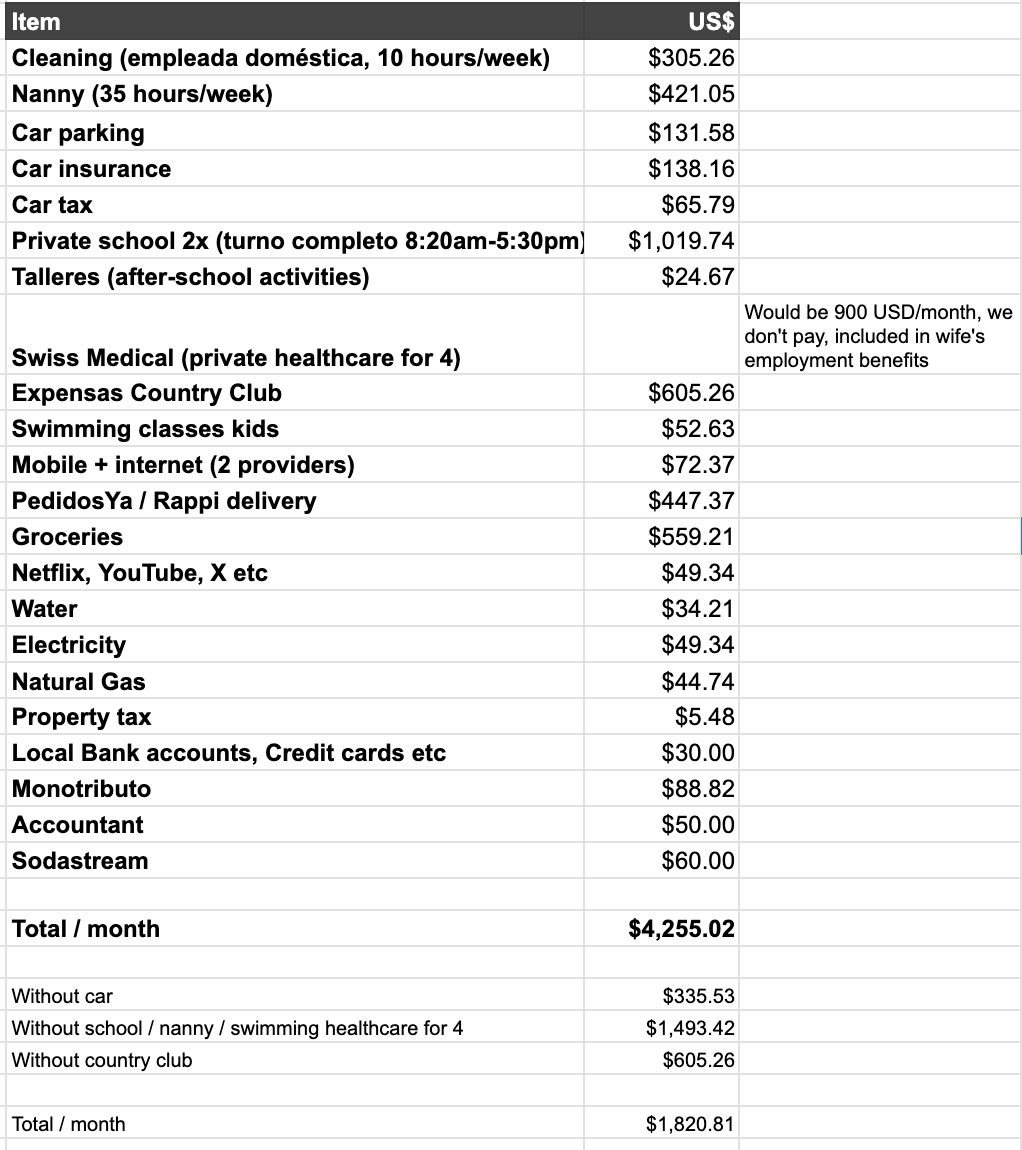
A conversation worth your time: I caught up with Mara today - not just to talk cost of living, but to dig into whether this whole basic system works for someone other than myself. He's been running the basic structure for a while now, using it to try to replace a chunk of agency income he's at risk of losing this September.
His answer, in his own words: it took a couple of months to click, but once it did, risk turned out to be minimal and the passive income real.
If I take the high end estimate of $55,000 and could theoretically scale the above returns of the basic ABX trade at 24% PA the required capital to cover such expenses would be $55,000/0.25 = $229,166.67 in working capital required.
Obviously one would include a buffer, calculate a range of likely return scenarios, account for inflation and withdrawal rates etc and not rely on such a calculation down to the decimal place, but thinking for oneself using first principles math and a little outside-the-box creativity can give a sense of what’s possible; living a comfortable lifestyle with much less starting capital than might otherwise be expected.
Where the edge actually is
What you’ve just read is the shallow end. The simplest tactic in the system. If you’re interested in accessing the entire playbook: every trade, position sizing, and the alerts as they go out — that’s what premium membership is for.
Use this code for 25% off your premium subscription - Forever!
Disclaimer
Machina Capitalis is a personal publication produced for informational and educational purposes only. It documents the author’s own opinions, research, and trading activity. Nothing in it constitutes financial, investment, legal, tax, or accounting advice, nor a recommendation, offer, or solicitation to buy, sell, or hold any security, derivative, or other financial instrument.
The author is not a licensed financial adviser, broker, or registered investment professional, and no advisory or fiduciary relationship is created by your reading this publication or holding a subscription to it. Content is general in nature and does not account for your objectives, financial situation, or needs. Before acting on anything discussed here, conduct your own research and consult a licensed professional in your jurisdiction.
Options, margin, and short selling carry substantial risk and are not suitable for every investor. Strategies involving short options or inverse and leveraged instruments can result in losses that exceed the capital initially committed, in some cases without limit. Returns, yields, and annualized figures cited are specific to the author’s positions, timing, and account, are frequently illustrative or estimated, and should not be relied upon. Past performance — the author’s or anyone else’s — is not indicative of and offers no guarantee of future results.
The author holds, and actively trades, positions in many of the securities and instruments mentioned, and those positions may change at any time without notice. Statements about the author’s intended actions are not commitments and may not be acted upon. Prices, figures, and positions referenced were current only as of the time of writing and will have changed.
Information believed reliable at the time of publication may contain errors or omissions, and is not updated for subsequent developments. To the maximum extent permitted by law, the author accepts no liability for any loss arising from reliance on this material. You act on it entirely at your own risk.
This piece is a record of my own trading for educational and illustrative purposes. It is not financial advice, not a recommendation, and not a solicitation to buy or sell any security. I hold the Abacus position described, and I may add to it, reduce it, roll it, or close it at any time without notice. Nothing here accounts for your circumstances, goals, or risk tolerance.
Options carry substantial risk and are not suitable for every investor. A covered call caps your upside and does not protect against loss below your net cost basis; writing calls against shares you do not own is a different and far riskier proposition that I am not describing here. Averaging down into a falling position can compound losses as easily as it lowers a cost basis. You can lose money — including more than you expect — trading these structures.
All prices, figures, and probabilities are as at the dates stated and will have changed by the time you read this. I am a private investor sharing my own process, not a licensed adviser. Do your own work, and consult a licensed financial professional who knows your situation before acting on anything you read here.
Profit & Loss Statement


