

I closed 3 trades this week. Over the life of these trades I made a profit of $5,301 which required $43,227 in cpaital, for an annualised return of 34.5%.
That’s not the impressive part.
What is impressive is that none of them relied on the stock to go up in order to achieve those returns. The return was set the day each trade was opened.
The Big Idea
Lock in a profit spread upon entering a trade, underwriting an extraordinary risk-adjusted return and hedging the downside all in 1.
The Concept Behind This System
Most investors buy a stock and hope it goes up. In this system, I want to be able to profit no matter which direct the stock goes. Before execution, I calculate the most I can make, and how far the stock can move with the position still being in profit.
I lock in a spread at a price where, if the shares rise and are called away, the return on my capital is still above average. If they fall, I am well protected from loss.
That’s not to say loss is impossible, nor that adjustments won’t be required along the way, but rather I have a wide range of profit-zone and I know all my numbers when I enter the trade.
Every setup has to pass three tests:
It needs a fat downside cushion beneath it.
It needs to return at least 20% a year if I’m assigned.
And it needs to hold up if the market has a bad day, or a bad year.
One tactic I like to use to achieve the above is the In-the-money (ITM) buy-write.
How It Works
The mechanics are super simple. I buy the shares and, at the same time, sell a call option with a strike below the current share price. The buyer of that call pays me a premium up front, and that premium comes straight off what I paid for the shares — thus reducing my breakeven.
3 numbers tell me everything I need to know:
My net cost is the share price minus the premium.
My downside cushion is the premium as a % of the price, which is how far the stock can fall before I’m out of pocket.
My locked spread is the strike minus my net cost. This is the profit I keep if the shares are called away.
Why sell the call in the money?
Because that’s where the premium is richest. A bigger premium means a deeper cushion and hence the overall position becomes much less sensitive to stock price fluctuations. It also flips the usual fear on its head. With an in-the-money call, having my shares called away isn’t the risk. It’s the goal, because that’s when the spread is paid in full.
There is a cost to all this of course. My upside is capped at the strike, hence no matter how far the stock runs, my upside is capped.
Trade review: The ITM Buy-Write in Practice
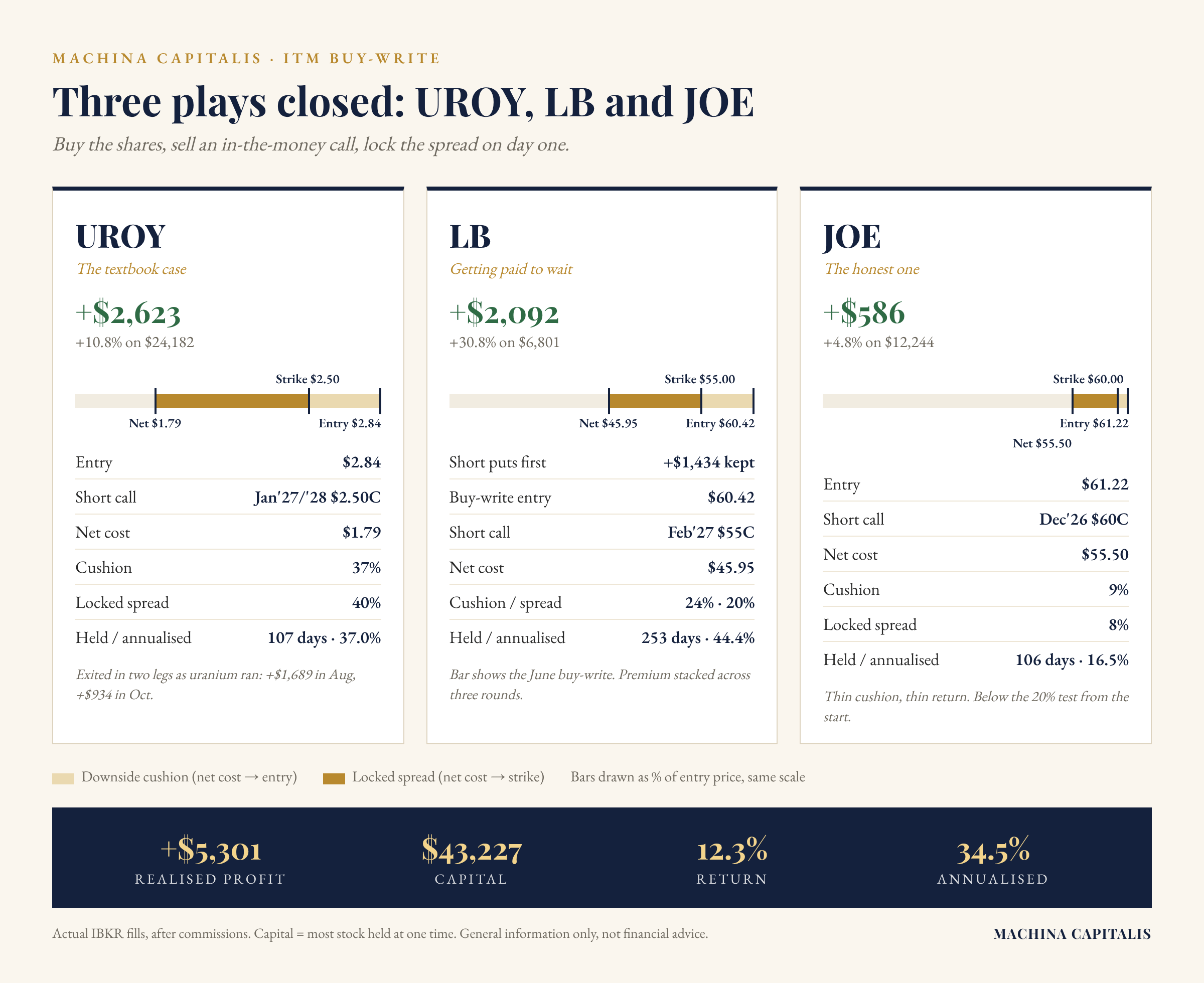
Between 19 and 21 October 2026 I closed three plays: Uranium Royalty (UROY), LandBridge (LB) and St. Joe (JOE). All three closed in profit, for +$5,301 realised on $43,227 of capital, a 12.3% return, or 34.5% annualised.
Each play was an example of the ITM buy write. By the exit, every stock was trading above the strike of the calls I had sold and had little time premium left. So I bought the calls back and sold the shares for a total profit.
Below is each trade from entry to exit, with the actual fills from Interactive Brokers, after commissions.
1. UROY: +$2,623 on $24,182 (+10.8%)
The largest of the three, run on the basic system for 107 days, 6 July to 21 October.
Entry, 6 July. I bought 8,500 shares at $2.84, for $24,182. Against them I sold 50 Jan’28 2.5 calls at $1.24 and 35 Jan’27 2.5 calls at $0.80. That brought in $9,007 of premium and cut my net cost to $1.79 a share.
First exit, 21 August. UROY rallied to $4.35. I sold 5,000 shares for a $7,505 gain and bought back the 50 Jan’28 calls at $2.40, a $5,816 loss on that leg. Net, +$1,689.
Final exit, 19–21 October. I bought back the 35 Jan’27 calls at $1.15 (−$1,229) and sold the last 3,500 shares at $3.48 (+$2,163). Net, +$934.
The calls cost money to unwind when the stock rallied, as they are meant to. They are the price of the premium that lowered my cost basis and cushioned the downside while I held.
2. LB: +$2,092 on $6,801 (+30.8%)
The longest campaign, 253 days from 9 February to 20 October, in three rounds.
Round 1, short puts (different tactic), February to April. I sold one Dec’26 40 put at $4.80, two Dec’26 55 puts at $6.85 and five Dec’26 40 puts at $2.80. I bought all of them back early, by 26 May, and kept $1,434 of the premium.
Round 2, buy-write, 30 March. I bought 100 shares at $68.01 and sold a May’26 40 call at $28.45, for a net cost of $39.56. The shares were called away at $40 on 15 May. Net, +$42.
Round 3, buy-write, 25 June. I bought 100 shares at $60.42 and sold a Feb’27 55 call at $14.47, for a net cost of $45.95. On 19–20 October, with LB at $80.75, I bought the call back at $28.60 (−$1,415) and sold the shares (+$2,031). Net, +$616.
3. JOE: +$586 on $12,244 (+4.8%)
A simple buy-write, held 106 days from 6 July to 20 October.
Entry, 6 July. I bought 200 shares at $61.22, for $12,244, and sold two Dec’26 60 calls at $5.72, collecting $1,144. Net cost, $55.50 a share.
Exit, 19–20 October. JOE was at $67.95, well above the 60 strike. I bought the calls back at $9.50 (−$758) and sold the shares (+$1,344). Net, +$586.
This was the smallest return of the three. Selling an in-the-money call capped the upside from the start; the trade was built to earn the premium, not to ride the stock.
Total Scorecard: 12.3% ROIC or 34.5% annualised
The above statistics IMHO do not fully capture the benefits of this tactic and understate the risk-adjusted returns.
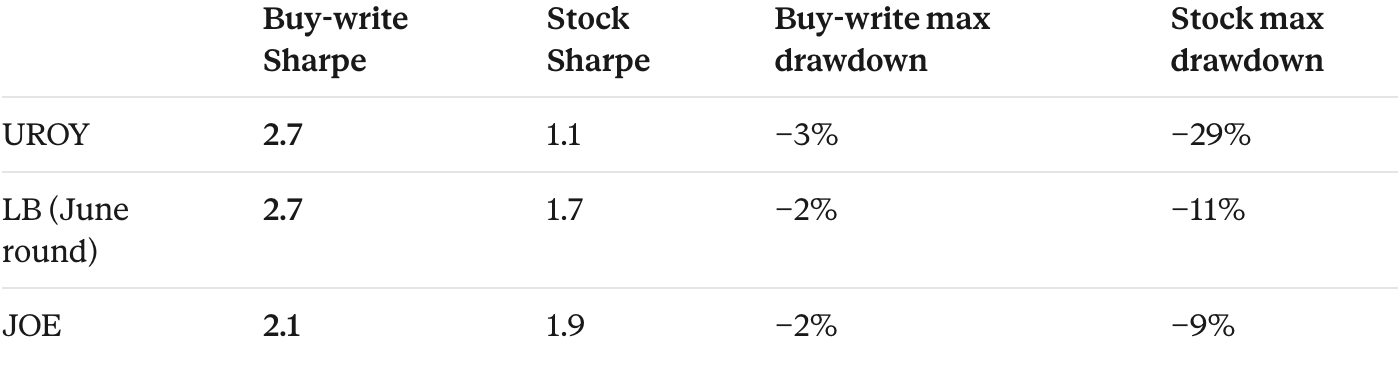
On a risk-adjusted basis, all three trades beat simply holding the stock even though in raw dollars, holding the stock would have made more. This is obviously because all three names rallied. The point of the hedges in this strategy is to provided risk-adjusted income.
Further Explained:
Less risk per dollar earned. The buy-writes ran at roughly a fifth of the stock’s volatility, so each unit of risk earned more. UROY is the clearest case: the stock fell 29% from its peak while the position barely dipped 3%.
The upside cost was real. Holding the shares alone would have returned more overall across the same windows (UROY ~21%, LB ~31%, JOE ~14%), but with the full drawdown. That’s the trade you’re making: you give up some upside to get the cushion.
JOE was barely better than the stock. Its Sharpe was only slightly ahead. That fits the thin 9% cushion. This is due to lower vol premiums in its option chain.
Holding the shares would have made more, but with up to almost 10x the drawdown in some cases. The buy-writes earned more per unit of Vol-risked in any given trade.
When To Use This Tactic?
I like to use it when implied volatility is high and I would be happy to hold the stock for an indefinite period if required. It works particularly well with dividend paying stocks because, as the owner of the underlying shares, I am entitled to the dividends paid for as long as I own the shares.
I don’t use this in my long term investing of course, or with a stock you expect to run hard, or when the time value is too thin to pay for the capital tied up. Naturally the premium received must be sufficient to underwrite a profit of 20%+ per annum in the case of assignment.
Pro section — Week 19–23 October 2026
This is the free half. The Pro Section is where members get full insights into what I’m doing.
As a Pro subscriber you get:
Every trade. Entries, strikes and limit prices posted in the chat when I place them, not a week later.
The full weekly book. Every roll, adjustment and close, with the reasoning and true campaign breakevens.
My upcoming actions