

Don’t forget to grab your ticket to the Rule Symposium below.
Machina Capitalis is my personal money machine.
Its purpose is to generate borderless income for me via: systematic options selling and exotic trading strategies. It is to be thought of not as a portfolio but rather as an operating company. It is not a paper portfolio. These are my own positions, my own thinking, and my own risk. I document every trade and share every detail with members in real time.
My skin is in the game.
Performance YTD +56.56%
Nothing here is financial advice — Caveat lector!
I was pleased to receive a message from my good friend BowTiedMara yesterday who was thrilled with the results he’s enjoyed trading options and running the Machina Capitalis playbook. He now has his own personal Machina.
He did mention however, that it isn’t the easiest of material to pick up — a sentiment shared by many if not most people when beginning their study of options as a way to make money. Therefore today I attempt an analogy which hopefully makes more intuitive sense to you dear reader so that things ‘click’ a little easier.
I have more than 8 different options tactics I use from time to time but I have to say, this is becoming my favourite as it’s elegantly simple and super profitable!
In a nutshell; I buy stocks I like and immediately sell someone else the right to buy them from me later at an agreed price. They pay me upfront for that right. I keep the cash no matter what happens.
To add some colour; imagine I own a warehouse and buy a fridge from a wholesaler for $100 on the 1st of January 2026, yet I’m nervous about the consumer economy and, whilst I have plenty of capacity to store the fridge, want to keep a certain amount of inventory turn-over sales to meet my income needs and I don’t want to have to discount at fire-sale prices later in the year in order to do so.
Ergo, I put a sticker on it, offering the right (option) to buy the fridge at only $71.43 (you’ll understand why so specific momentarily). To reserve the right to this bargain I ask for an upfront payment of $40.79 and set the expiration date for this offer at August 12, 2026. As such, the buyer of the option has the right to buy the fridge at $71.43 no matter what happens over the next 223 days, however after that the option expires worthless.
Why would someone pay me for this?
Well, the buyer also lives in an uncertain world and might expect the fridge to cost a lot more in the future than today. Perhaps they’re a fridge-speculator and have reason to believe that this particular model will sell for much more than $112.22 ($71.43+$40.79) by August. Or perhaps, the buyer lives in a country with rampant inflation - like a friend of mine, Hernán, who makes and sells doors and gates for wealthy country-clubs in Argentina. During lunch in 2023 he told me that he and his crew had to increase their prices by 7% per month on average in order to keep pace with inflation. Our fridge buyer in this case needs ‘merely’ 1.6% monthly compounded inflation in order to break even on his option.

So then, why would I do this you may ask?
Sticking with such a creative analogy, let’s say that prior to selling fridges I ran a hedge fund and I made my living from (apart from egregious fees) hedging my trades and arbitraging the spread. Here I was not so interested in whether a given stock price might go up or down over a given period but rather wanting to enter trades with a pre-determined buy low-sell higher feature locked in.
Let’s further assume that I apply this approach and to my retailing and explore the outcomes.
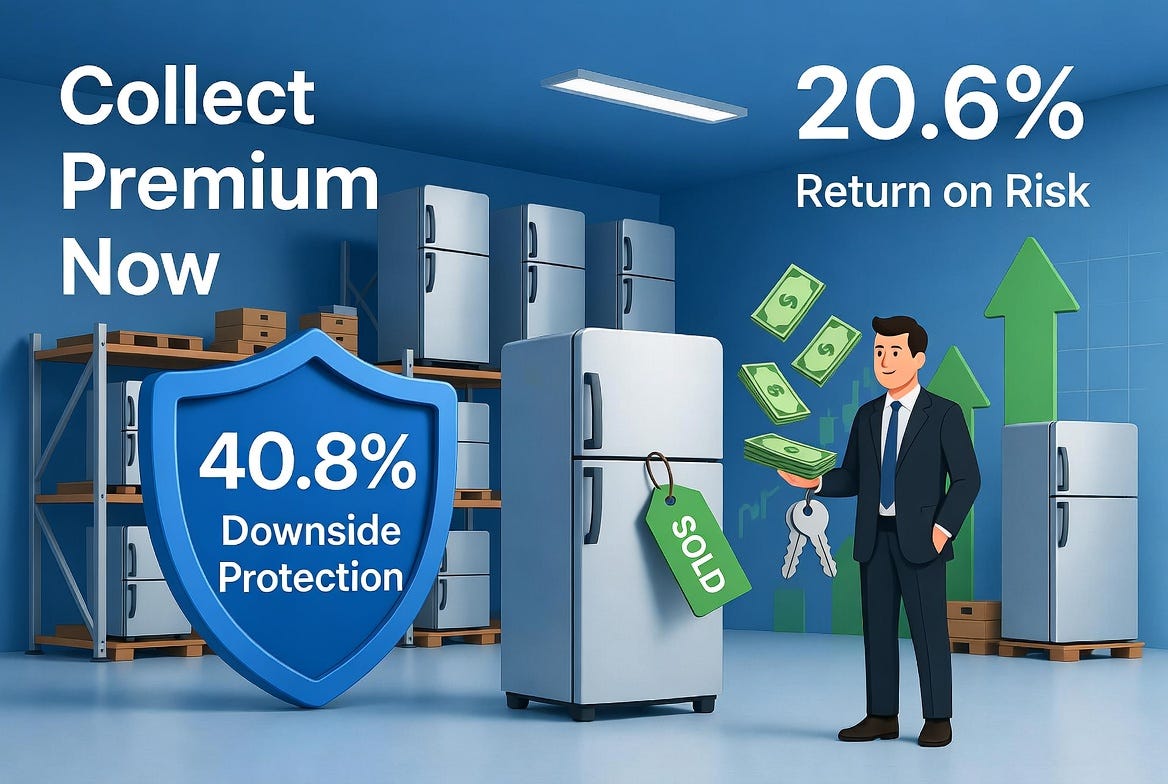
If indeed fridge prices rise rapidly and exceed the $112.22 total break even price for the buyer before the expiration date in August, he will no doubt exercise that option and purchase the Fridge at the agreed price of $71.43. In this case, I as the vendor will have made $112.22 in total cash and will wonder why I ever bothered with Wall St given that I just made profits of 20.63% in 223 days or 33.8% annualised, whilst lowering my capital risk by 40% (my breakeven cost after selling the option moves to $59.21) — and I didn’t even have to fight with limited partners over fees and/or redemptions etc!
But what if there’s a fridge-glut or other such circumstance that causes Fridge prices to drift sideways to down over the 223 days?
Well, after the initial contract expires I am free to sell a new option. My breakeven is now effectively $59.21, meaning I can write a ticket for any price above that whereby the same terms will apply as before (I can also change the dates or time to expiry). Theoretically I could continue such a practice, recycling sales on the same asset until such a time when prices eventually rise pass the strike or sale price. One can imagine the potential returns on original capital such a strategy might offer when the tactics are soundly executed.
Alternatively, I could instead choose to buy more fridges at the depressed price levels if I believed they were high-quality assets whose time would come again. Say I buy another fridge in August after expiration at the going rate of sub $72, now I can sell options on 2 fridges at prices that make sense to me and have enough market interest. The reader can ponder the compounding consequences of this for themselves.
*Sidenote; if fridges paid dividends, they would also accrue to me - thus increasing my rate of return.
What’s the risk?
Easy. The price of the fridge goes to zero before I’ve sold enough options on it to recover my capital.
This can be mitigated by selecting quality fridge models whose value I believe I can judge better than the market is pricing and judiciously underwriting my forward-sales-rights (options).
How do I make money from this and why am I’m I talking about fridges?
Substitute the word ‘fridge’ for ‘Landbridge stock’ and change the pricing to the appropriate ratio (i.e from $100 fridge price to LB stock price, today $64.98) and you now have an idea of how I am making the equivalent returns with the same trading tactic.
Whilst the analogy above is preposterous, I promise you it is the main tactic I am running right now with the same equivalent expected returns baked in - only I’m doing this on stocks I love (because it’s difficult to travel with so many fridges!).
Substitute fridge for Landbridge — ($LB) trading today at $64.98 — and you have the exact trade I'm currently running inside Machina Capitalis. The strike price, the premium collected, the breakeven, the annualised return + the full position sizing rationale are waiting for you on the other side, along with equivalent trades for Abacus life & GLXY.